Thematic
There are 1849 products.
Roman sword with sheath
Roman Spatha, long sword with scabbard, 2nd .C., decorating sword
This spatha is not an individual replica of a real historical piece, but a reconstruction based on original discoveries from the end of the 2nd century now maintained at the Limesmuseum in Aalen (Baden-Württemberg, southwestern Germany).
€137.00
€171.25
Spear point
Last items in stock
Medieval spear of 22 cms. It corresponds to the end of the Middle Ages. Made of carbon carbon forged steel.
€26.35
€32.93
Viking sword with sheath
Viking sword with brass cape
This Viking-Era sword, which has the characteristic appearance of a Viking sword type D according to the Vikingesverd typology of De Norsk by Jan Petersen (1919), is a replica of an archaeological find on the Scottish island of Eigg.
It features a high carbon steel blade of double-edged blunt with a full width. The finely crafted handle, guard and handle are in bronze.
€295.08
€368.85
Roman sword with sheath
Roman Buch-Podlodów type Spatha with sheath, 3rd century .C., sword decoration
This Roman Spatha is a reconstruction based on several third original c. examples found near Podlodów (present-day Poland) in the archaeological region of przeworsk culture. A few more Podlodów-type blades were also found along or near Limes, the border of the Roman Empire. It is assumed that most of these spatulas originated from Roman blacksmiths and had eventually found their way beyond the borders of the Empire to Barbaricum.
€137.00
€171.25
Viking sword with sheath, Damascus steel
Scandinavian sword of the Vendel period with brass handle and steel blade of Damascus
This beautiful sword from the Vendel period is inspired by a finely crafted and richly decorated find, excavated from the grave of a ship in a ship cemetery near Uppsala, Sweden. Due to its sumptuous and intricate details, the original archaeological piece is believed to have been the prestigious weapon of the 7th / VIIIth century. Many artifacts attributed to the Vendel era (approximately between the migration period and the Viking era in Swedish history) testify to the high quality of craftsmanship that could be achieved at that time.
€400.47
€500.59
Roman sword with sheath
Roman Fulham Type Gladius with sheath, 1st .C., sword decorationThe gladius, the main weapon of the Roman legionaries from 3rd c. BC to the 3rd c. AD, has been used in many variations over the centuries. Primarily designed as a storage/stab gun, it was also quite effective at cutting or cutting. Eventually, this highly feared short sword was gradually replaced by the longest spatha during the mid/late Roman Empire.
€118.08
€147.60
Panoply with pectoral and 2 swords
Wooden clothplia with pectoral and 2 swords from medieval European S.VI-XV.
€34.78
€43.47
Viking sword with sheath
Viking Temple Sword with Sheath
The Viking sword or Carolingian sword was a type of sword used in western and northern Europe in the early Middle Ages. The "Viking sword" was developed from the Roman Spatha and was used by the Franks in the Carolingian period (751 to 911).
€147.54
€184.43
Roman sword with sheath
Mainz-Fulham Roman Legionnaire Gladius type with sheath, 1st century .C., decorating sword
The gladius, the main weapon of the Roman legionaries from 3rd c. BC to the 3rd c. AD, has been used in many variations over the centuries. Primarily designed as a storage/stab gun, it was also quite effective at cutting or cutting. Eventually, this highly feared short sword was gradually replaced by the longest spatha during the mid/late Roman Empire.
€168.62
€210.77
Testicular dagger with sheath
Medieval testicular daga. The handle is made of wood and the genuine leather hem. The dagger and hem have a brass décor.
€73.80
€92.25
Gladius sword with sheath
Roman Xanten Gladius with scabbard, 3rd .C., sword decorationThe gladius, the main weapon of the Roman legionaries from 3rd c. BC to the 3rd c. AD, has been used in many variations over the centuries. But eventually, this highly feared short sword was gradually replaced by the longer spatha during the Roman Empire.
€147.60
€184.50
Gladius sword with sheath
Roman Pompeii gladius type with scabbard, 1st century .C., sword decoration
The gladius, the main weapon of the Roman legionaries from 3rd c. BC to the 3rd c. AD, has been used in many variations over the centuries. But eventually, this highly feared short sword was gradually replaced by the longer spatha during the Roman Empire. The type of Pompeii, gladius (or gladius pompeianus), which replaced the type of Mainz in the mid-1st century AD, constituted the final evolutionary stage of the Roman short sword. This late variant was named after the famous Italian archaeological site, where the four canonical examples were found (dated before 79 AD, the year of the devastating volcanic eruption of Vesuvius that buried the city under several meters of ash).
€137.76
€172.20
Gladius sword with sheath
Roman Mainz Type Gladius with sheath, 1st century .C., sword decoration
The gladius, the main weapon of the Roman legionaries from 3rd c. BC to the 3rd c. AD, has been used in many variations over the centuries. Primarily designed as a storage/stab gun, it was also quite effective at cutting or cutting. Eventually, this highly feared short sword was gradually replaced by the longest spatha during the mid/late Roman Empire.
€147.60
€184.50
Viking Sword Ulfberht with leather hem
Last items in stock
Viking Sword Ulfberht
Before the Ulfberht swords, most European swords were of the standard soldier type. Soft iron bars were welded with steel strips,
forged in the shape of a blade, then a steel blade was welded to the sword. The Ulfberht sword was a great leap in technology and design.
Before the Ulfberht swords, most European swords were of the standard soldier type. Soft iron bars were welded with steel strips,
forged in the shape of a blade, then a steel blade was welded to the sword. The Ulfberht sword was a great leap in technology and design.
€242.39
€302.99
Mini Shield Toledo
Miniature Toledo medieval shield with grenade and blue background. As a central transition motif, the two-headed eagle symbolizes the city of Toledo (Spain).
€42.15
€52.69
El Cid Mini Shield
Medieval shield El Cid Miniature Escalator decorated in red and white barracks with motifs and ramplane lion castles.
€42.15
€52.69
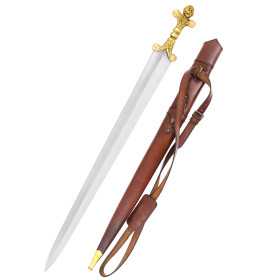
Celtic sword with leather hem
Celtic Longsword with Sheath
The original of this decorative replica of a Long Celtic sword dates from the 1st century BC (era of La Tène). The blade is forged in flexible steel, while the beautiful and richly decorated handle represents a warrior and is blown into brass.
The sword comes with a leather sheath matching brass accessories and a sword belt.
Details:
- Blade material: en45 spring steel
- Total: about 96 cm
- Blade length: approx. 79 cm
- Including a matching leather hem
- Weight (without sheath): approx. 1.65 kg
€186.96
€233.70
Protection for metal arms (Pair)
Wearable and flexible replica of a late medieval air harness, also called brassard, consisting of superior steel pipes, cables and lower bullet tubes.
The arms can be adjusted by means of three internally mounted leather straps.
The shoulder part of the arm harness was created to fit the Gambeson or can be connected to another plate armor, e.g. gorgets or breastplate.
The arms can be adjusted by means of three internally mounted leather straps.
The shoulder part of the arm harness was created to fit the Gambeson or can be connected to another plate armor, e.g. gorgets or breastplate.
€275.52
€344.40
Late Viking Era sword with sheath, brazil nut cuff
In the high Middle Ages, Viking swords began to lose some of their most characteristic features, such as the wide, tapered blade and the fist with lobes. Viking swords began to look more like the long swords characteristic of the Middle Ages.
€147.54
€184.43
Norman Standard (65x104 cms.)
Last items in stock
Banner-Flag Quarter medieval Edward III, with Lions and Lys Flower emblazoned on a 100% cotton background. Size (65 x 104 cm)
€42.15
€52.69
Knight Helmet
This helmet has a brass nose guard and a steel cover with an aged finish. Wear leather straps on the crown and a horsehair ponytail. It has an adjustable leather lining and chin strap. The mesh dimension protects the neck.
Approx. 66 cm inner circle with adjustable leather lining and chin strap.
Weight: 1,530 g
Approx. 66 cm inner circle with adjustable leather lining and chin strap.
Weight: 1,530 g
€130.48
€163.10
Celtic Antenna Sword without sheath
With the generic name of Celtic are known many warrior cities of central Europe, as well as one of the British isles and even Norway of Spain. Vercingetorix was the chief who managed to group the Celtic tribes of Gaul to face Julius Caesar at the Battle of Ahesia. Art Gladius makes this Celtic sword from the early 1st century, highlighting the dragons of the guard and the carving of the cape
€94.85
€118.56
Viking dagger with sheath
Viking dagger with carbon steel blade. Fist and guard in brass.
Includes sheath
Details:- Total length: approx. 34.5 cm- Blade length: approx. 19.5 cm
Includes sheath
Details:- Total length: approx. 34.5 cm- Blade length: approx. 19.5 cm
€18.97
€23.71
Sword Gladius wood
Wooden practice gladius
Gladiators used wooden swords to train.
Gladiators of remarkable merit received a wooden sword as a sign of freedom after retiring.
A useful training sword, not just for gladiators.
Details
- Material: hose wood
- Length: approx. 70 cm
- Weight: approx. 250 g
Gladiators used wooden swords to train.
Gladiators of remarkable merit received a wooden sword as a sign of freedom after retiring.
A useful training sword, not just for gladiators.
Details
- Material: hose wood
- Length: approx. 70 cm
- Weight: approx. 250 g
€29.52
€36.90
Leather wristguard, Celtic boar motif, pair
These beautiful high quality wrist cuffs are made of thick leather and dyed vegetable tanning and lined with soft suede inside for added comfort. Each clamp/clamp is adorned with a riveted Celtic boar fused into finely detailed old-fashioned brass. The arm protection is surrounded by dome-shaped studs and eyelets, also made of antique brass, and equipped with a sturdy leather rope for a suitable bow.
€42.15
€52.69
Leather clamp with steel stripes
Leather clamp with steel straps
This sturdy and beautiful leather clamp provides the re-director (Archer or Infantry) with support and protection for the forearm. It is handmade from approx. Bovine leather 5 mm thick and two handles with buckles with which the desired size can be adjusted perfectly. The leather is reinforced with three steel strips, which makes this arm protector suitable for use in combat.
€31.62
€39.52
Roman Helmet
Imperial Roman Helmet Gallic -G- Weisenau, steel, crested
€196.80
€246.00
 (280 × 350 px) (1)_2.png)
.png)