Active filters

  • Categories: Freemasons Hold Swords clear
  • Categories: Roman Swords clear
  • Categories: Swords in Madeira clear
Romana Gladius sword with sheath
Replica of a Roman Gladius, as carried out by the Roman legionaries around the time of Christ's birth.Pommel and guard are made of beautiful wood. The handle is made of genuine animal bone. Steel blade and pommel are screwed together.The sword comes with a wooden sheath with brass ornaments.An introductory model accessible, but quite suitable for Roman re-enactment.
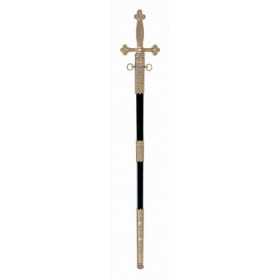
Sword of King Solomon cadet
Exclusive Solomon Cadet Sword with aged silver finish. Excellent Sword Cadet Solomon from the Exclusive Collection "Cadet of Historical Swords" manufactured by MARTO. Certificate of Quality and Origin. Made in Toledo.
Romana Gladius sword with sheath
One of the weapons with which legionnaires conquered the great parts of Rome of the world known at that time was the short sword. The different types are categorized primarily based on the blade or the site.

This sword (Latin Gladius) is of the Mainz type with a double-edged blade. It is extremely efficient for slash and sting techniques and was a dreaded melee weapon.

This replica has an EN45 spring steel blade, which is not sharp. The cable is made of wood and bone.

The ornate sheath is made of leather-wrapped wood, which features fittings made of brass and laminated metal.
A leather strap, attached to the transport rings, ensures a comfortable carriage of the sword.
Gladius sword with sheath
The gladius, the main weapon of the Roman legions, was used in many variations from the 4th century BC until the 3rd century AD. Pompeii gladius is one of the latest versions of the Roman short sword. It was named by modern historians after the Italian archaeological site, where the four canonical examples (dated before 79 AD, the year of the devastating volcanic eruption of Vesuvius, which buried the city under several meters of ash) were found.
Gladius sword with sheath
One of the weapons with which legionnaires conquered the great parts of Rome from the then-known world was the Gladius. The different types are categorized primarily based on the blade or the site.
This sword (Latin Gladius) is of the Mainz type with a double-edged blade. It is extremely efficient for slash and sting techniques and was a dreaded melee weapon.
This replica has an EN45 spring steel blade, which is not sharp. The handle and button are made of wood.
The hem is made of leather and has exquisitely decorated brass ornaments and metal plates, which show the Roman emperors Augustus and Tiberius, and wear rings on the sides of the hem.
Solomon Sword
Solomon, king of Israel (sX BC), was the second son of Uriah's wife Bathsheba, which his father, David, had taken as his wife.
He reigned in Israel between 970 and 931 BC and was known and respected for being a wise, just, and powerful king.
Solomon Sword
The claymore sword was a two-handed sword or a Scottish knight, used in battle to be able to keep enemies at a distance given its size and strength. It is the sword model used by William Wallace in the film Braveheart. This replica is made of high quality stainless steel and is 115 cm long
Sheath for Marto Masonic Swords
Last items in stock
Scabbard for SwordsMasonic Marto Unique and high quality scabbard for the following Marto brand Masonic swords:MT-775MT-776MT-MA775MT-MA775.1Made of wood and covered in leather. Adorned at both ends with nickel-plated metal fittings. Includes a leather belt for fastening at the waist.Details:- Material: wood and leather- Weight: approx. 0.5 kg- Manufacturer Product No.: V776
Roman spatha with hem
The Spatha (Latin for "broad blade") is a double-edged sword with a straight blade. This form of sword existed around the 1st century BC. Until the end of the early Middle Ages. The Romans used the Spatha until the fall of the Roman Empire.

Gladius Sword
Last items in stock
The Gladius Romana, mainz type, was used between the 2nd century BC and the 1st AD This specially ornate replica has a stainless steel blade. very characteristic, decorated with deep engraving and aged silver finish.


Pompeiglad
Features:

- Measures:
Total: 77 cm
Sheet: 56 cm
Handle: 21cm
- Weight: 1,220 gr.
Termination in aged silver. Stainless steel plate and thickness of 4 mm
- Cable: beech wood and iron
Gladius Launcher
Last items in stock
Gladius Launcher

Designed by Cold Steel President Lynn C. Thompson, the Gladius Thrower features a one-piece hardened steel blade with a wide Roman point. Its excellent weight and balance make it an excellent launcher even over long distances.

Designed to stick with its sturdy stitch or tapered butt, the Gladius Thrower makes a fun and unusual sport launcher. Flinging and hitting a satisfying, it will certainly be an unusual and much-talked about addition to any collection of knife throwers.

Details:
- Material: Steel S50C
- Total length: approx. 35.6 cm
- Blade length: approx. 21 cm
- Blade thickness: approx. 5 mm
- Handle length: approx. 14.6 cm
- Weight: approx. 303 g
Roman sword with sheath
Roman Spatha, long sword with scabbard, 2nd .C., decorating sword
This spatha is not an individual replica of a real historical piece, but a reconstruction based on original discoveries from the end of the 2nd century now maintained at the Limesmuseum in Aalen (Baden-Württemberg, southwestern Germany).
Roman sword with sheath
Roman Buch-Podlodów type Spatha with sheath, 3rd century .C., sword decoration

This Roman Spatha is a reconstruction based on several third original c. examples found near Podlodów (present-day Poland) in the archaeological region of przeworsk culture. A few more Podlodów-type blades were also found along or near Limes, the border of the Roman Empire. It is assumed that most of these spatulas originated from Roman blacksmiths and had eventually found their way beyond the borders of the Empire to Barbaricum.

Roman sword with sheath
Roman Fulham Type Gladius with sheath, 1st .C., sword decorationThe gladius, the main weapon of the Roman legionaries from 3rd c. BC to the 3rd c. AD, has been used in many variations over the centuries. Primarily designed as a storage/stab gun, it was also quite effective at cutting or cutting. Eventually, this highly feared short sword was gradually replaced by the longest spatha during the mid/late Roman Empire.
Roman sword with sheath
Mainz-Fulham Roman Legionnaire Gladius type with sheath, 1st century .C., decorating sword
The gladius, the main weapon of the Roman legionaries from 3rd c. BC to the 3rd c. AD, has been used in many variations over the centuries. Primarily designed as a storage/stab gun, it was also quite effective at cutting or cutting. Eventually, this highly feared short sword was gradually replaced by the longest spatha during the mid/late Roman Empire.
Gladius sword with sheath
Roman Xanten Gladius with scabbard, 3rd .C., sword decorationThe gladius, the main weapon of the Roman legionaries from 3rd c. BC to the 3rd c. AD, has been used in many variations over the centuries. But eventually, this highly feared short sword was gradually replaced by the longer spatha during the Roman Empire.
Gladius sword with sheath
Roman Pompeii gladius type with scabbard, 1st century .C., sword decoration

The gladius, the main weapon of the Roman legionaries from 3rd c. BC to the 3rd c. AD, has been used in many variations over the centuries. But eventually, this highly feared short sword was gradually replaced by the longer spatha during the Roman Empire. The type of Pompeii, gladius (or gladius pompeianus), which replaced the type of Mainz in the mid-1st century AD, constituted the final evolutionary stage of the Roman short sword. This late variant was named after the famous Italian archaeological site, where the four canonical examples were found (dated before 79 AD, the year of the devastating volcanic eruption of Vesuvius that buried the city under several meters of ash).


Gladius sword with sheath
Roman Mainz Type Gladius with sheath, 1st century .C., sword decoration

The gladius, the main weapon of the Roman legionaries from 3rd c. BC to the 3rd c. AD, has been used in many variations over the centuries. Primarily designed as a storage/stab gun, it was also quite effective at cutting or cutting. Eventually, this highly feared short sword was gradually replaced by the longest spatha during the mid/late Roman Empire.

Sword Gladius wood
Wooden practice gladius

Gladiators used wooden swords to train.
Gladiators of remarkable merit received a wooden sword as a sign of freedom after retiring.

A useful training sword, not just for gladiators.

Details
- Material: hose wood
- Length: approx. 70 cm
- Weight: approx. 250 g
Roman sword with sheath
Roman sword Spatha cavalry, with antique gold finishes on the handle, guard and fist. With a total size of 80cm, steel blade with imitation apricot. Black Continene cape lined in red synthetic leather with antique gold details.
Total size: 80 cm
Sheet size: 50cm
Blade thickness: 3 mm
Gladius Sword
Roman cavalry sword Spatha, finished in nickel on the handle, guard and handle. With a total size of 80 cm, steel blade with imitation apricot. Black Continene cover lined in brown synthetic leather with nickel details.

Total size: 80 cm
Sheet size: 50cm
Blade thickness: 3 mm
Honshu Spartan with hem
The Spartan Sword is an exceptional addition to Honshu's solid line of tactical weapons. Always innovative and always at the forefront of the industry, United Cutlery blades are intended for real-world use, so their construction has unparalleled strength and quality! This reimagining of an ancient weapon has a 16 1/2" 7Cr13 stainless steel blade that features a phenomenally sharp blade, which features a classic blood groove and modern weight reduction holes in the spine.