Swords and Sabres
Subcategories
There are 92 products.
Sica Sword
The sica was a curved dagger on one side, with thrakian-illirian origin. In Rome, the sica was mainly used by gangs of thieves, who were called sicarii. This weapon was also used by the thraeces, a special type of gladiator.
This reproduction of a sica features the classic curved blade, which is made of en45 spring steel. The blade is not sharp.
The handle, with handles and guard are made of skilled crafted wood. A brass plate has been inserted into the guard to ensure safety.
This reproduction of a sica features the classic curved blade, which is made of en45 spring steel. The blade is not sharp.
The handle, with handles and guard are made of skilled crafted wood. A brass plate has been inserted into the guard to ensure safety.
€52.69
€65.87
Sword of Julius Caesar (limited series)
The Sword of Julius Caesar with leaf, cross and button with details in Damasceno embedded in gold. It's a LIMITED EDITION.
€388.68
€485.85
Side sword
Main features:
- Authentic style
- Fully functional
-
Detailed details:
- Total length: approx. 95.9 cm
- Blade length: approx. 76.2 cm
- Cuff length: approx. 14 cm
- Weight: approx. 1134 g
Incl. leather covered hem
- Authentic style
- Fully functional
-
Detailed details:
- Total length: approx. 95.9 cm
- Blade length: approx. 76.2 cm
- Cuff length: approx. 14 cm
- Weight: approx. 1134 g
Incl. leather covered hem
€497.83
€622.28
Roman spatha with hem
Last items in stock
Final Roman Sword (Spatha)
Beginning around the 3rd century, the Romans began to adopt the long double-edged swords called Spathas,
which were originally used only against the Germans.
This replica is a reconstruction of a 4th century spatha.
The handle is carved into animal bone. The blade has two fullers.
The delivery includes a leather-wrapped wooden sheath with an authentic brass ornamentation.
€131.73
€164.67
Roman spatha with hem
Last items in stock
Roman spatha with sheath, 3rd century
From the 3rd century, the Romans adopted the long, straight double-edged swords of the Germanic people: the Spathae.
This replica is a reconstruction of a 3rd century AD spatha. The blade was forged from steel. The fist is made of bones. The wooden handle is covered with red leather and completed with authentic brass accessories.
€121.19
€151.49
Sword Rapier practices
they trace their origins to early 17th century Europe, where the sword with the tweezers was considered an essential part of a gentleman's education and was often used in resolving gentlemanly disagreements. The blades typically originated from Toledo or Solingen and would be caused by regional smiths, resulting in many range styles.
This reproduction has a high carbon steel blade and a very attractive solid (uncoated) steel basket with a genuine bone grip.
A rigid leather cover covered in leather is included.
This reproduction has a high carbon steel blade and a very attractive solid (uncoated) steel basket with a genuine bone grip.
A rigid leather cover covered in leather is included.
€505.85
€632.32
Sword Rapiera Gustavo II
Main features:
- High carbon forged steel blade
- leather sheath included
- Excellent balance
Details:
- Blade material: high carbon steel, tempered
- Total length: approx. 114.9 cm
- Blade length: approx. 93 cm
- Weight: approx. 1049 g
- Balance point: approx. 12.7 cm from guard
- Harmonic point: approx. 71.1 cm
- Blade width in protection: approx. 1.9 cm
- Blade width at tip: approx. 1 cm
- Blade thickness in protection: approx. 6.4 mm
- Blade thickness at tip: approx. 2.5 mm
Incl. leather hem
€484.78
€605.97
Sword Rapiera Torino
Last items in stock
Based on models of rapiers of Italian descent from the 17th century, Hanwei Torino Rapier displays the classic
Popular straight crossguard style in this part of Europe. The tweezers have classic lines, with a
carbon steel blade of high carbon content, a stainless steel handle (for reduced maintenance) with quillons of "blade collector" and a braided wire handle.
Popular straight crossguard style in this part of Europe. The tweezers have classic lines, with a
carbon steel blade of high carbon content, a stainless steel handle (for reduced maintenance) with quillons of "blade collector" and a braided wire handle.
€486.10
€607.62
Sword Rapiera practices
they trace their origins to Early 17th century Europe, where the sword with the Rapier was considered an essential part of a gentleman's education and was often used in resolving gentlemanly disagreements. This model features a well-balanced high-carbon steel blade with a solid steel basket (not plated) and a hard wood grip. The rigid hem is covered in leather.
€363.58
€454.48
Sword Rapiera Solingen
Main features:
- High carbon forged steel blade
- leather sheath included
- Excellent balance
Details:
- Blade material: high carbon steel, tempered with bending
- Total length: approx. 114.9 cm
- Blade length: approx. 93 cm
- Weight: approx. 1049 g
- Balance point: approx. 12.7 cm from guard
- Harmonic point: approx. 71.1 cm
- Blade width in protection: approx. 1.9 cm
- Blade width at tip: approx. 1 cm
- Blade thickness in protection: approx. 6.4 mm
- Blade thickness at tip: approx. 2.5 mm
Incl. leather hem
€492.00
€615.00
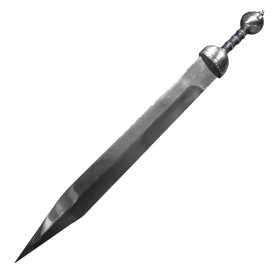
Romana Gladius sword with sheath
Replica of a Roman Gladius, as carried out by the Roman legionaries around the time of Christ's birth.Pommel and guard are made of beautiful wood. The handle is made of genuine animal bone. Steel blade and pommel are screwed together.The sword comes with a wooden sheath with brass ornaments.An introductory model accessible, but quite suitable for Roman re-enactment.
€103.32
€129.15
Romana Gladius sword with sheath
One of the weapons with which legionnaires conquered the great parts of Rome of the world known at that time was the short sword. The different types are categorized primarily based on the blade or the site.
This sword (Latin Gladius) is of the Mainz type with a double-edged blade. It is extremely efficient for slash and sting techniques and was a dreaded melee weapon.
This replica has an EN45 spring steel blade, which is not sharp. The cable is made of wood and bone.
The ornate sheath is made of leather-wrapped wood, which features fittings made of brass and laminated metal.
A leather strap, attached to the transport rings, ensures a comfortable carriage of the sword.
€186.96
€233.70
Gladius sword with sheath
The gladius, the main weapon of the Roman legions, was used in many variations from the 4th century BC until the 3rd century AD. Pompeii gladius is one of the latest versions of the Roman short sword. It was named by modern historians after the Italian archaeological site, where the four canonical examples (dated before 79 AD, the year of the devastating volcanic eruption of Vesuvius, which buried the city under several meters of ash) were found.
€126.46
€158.08
Sword King Charles III
Andspada Cazoleta by Carlos III in cadet size engraved and finished in rustic (steel tone). Blade in hardened stainless steel, forged and satin. Length 107 cm, weight 1300 grams
€94.85
€118.56
Gladius sword with sheath
One of the weapons with which legionnaires conquered the great parts of Rome from the then-known world was the Gladius. The different types are categorized primarily based on the blade or the site.
This sword (Latin Gladius) is of the Mainz type with a double-edged blade. It is extremely efficient for slash and sting techniques and was a dreaded melee weapon.
This replica has an EN45 spring steel blade, which is not sharp. The handle and button are made of wood.
The hem is made of leather and has exquisitely decorated brass ornaments and metal plates, which show the Roman emperors Augustus and Tiberius, and wear rings on the sides of the hem.
€231.85
€289.81
Scottish basket sword with sheath
Replica of a typical Scottish broad sword (Claymore) from the year 1828. The single edge blade is made of carbon steel and has two fullers. This sword has a very decorative basket and a leather covered wooden hem.
€179.16
€223.95
Rapier Bradenburg sword with sheath
Around the 17th century
This impressive 17th-century Rapier is elegantly hand-crafted. It has a metal basket with an elaborate braid to protect the hand. The finely carved horn handle mimics the elegantly rotated metal of the handle and is hand-crafted and inserted with a single steel wire that provides excellent grip during duels.
Hand forged steel blade, high carbon content. Rich with detailed engraving.
It includes leather hem with braided metallic décor that complements this magnificent and fast Rapier.
Length: 112 cm
Leaf: 95 cm; 2 cm wide; Thickness of 4.8 mm
Weight: 1,250 g
€263.47
€329.33
Roman spatha with hem
The Spatha (Latin for "broad blade") is a double-edged sword with a straight blade. This form of sword existed around the 1st century BC. Until the end of the early Middle Ages. The Romans used the Spatha until the fall of the Roman Empire.
€110.66
€138.32
Gladius Sword
Last items in stock
The Gladius Romana, mainz type, was used between the 2nd century BC and the 1st AD This specially ornate replica has a stainless steel blade. very characteristic, decorated with deep engraving and aged silver finish.
€158.08
€197.60
Rapiera sword with sheath
The design of this Rapier was quite popular in the late 16th century and early 17th. This model is hand forged by skilled craftsmen from Windlass Steelcrafts and has a high carbon steel blade with a diamond cross section. This gives firmness to the blade, but allows it to be flexible in action. The steel guard and decorated button are accented with a hardened and bleached bone grip.
€274.00
€342.51
Pompeiglad
Features:
- Measures:
Total: 77 cm
Sheet: 56 cm
Handle: 21cm
- Weight: 1,220 gr.
Termination in aged silver. Stainless steel plate and thickness of 4 mm
- Cable: beech wood and iron
- Measures:
Total: 77 cm
Sheet: 56 cm
Handle: 21cm
- Weight: 1,220 gr.
Termination in aged silver. Stainless steel plate and thickness of 4 mm
- Cable: beech wood and iron
€152.81
€191.01
Rapiera sword with sheath
Around the 17th century
Rapier of the seventeenth century beautifully executed with a very complex grip. Hand-rolled silver wire handle with rings at the top and bottom. The hand-forged blade, made of high carbon and fully tempered steel, has a wide channel to relieve and strengthen it in the thrust and a rich heavy that provides greater strength. This type of sword was used as a dueling weapon.
High quality genuine leather cover with floral print deeply engraved on the throat and tip.
€326.70
€408.37
Rapiera sword with sheath
Rapier Taza Cup-Hilt by Paul Chen
Long exalted as the pinnacle of rapier design, the Spanish rapier or cup-hilt no doubt combined style and
work very effectively in 17th-century Europe.
and Hanwei's Paul Chen replicated them perfectly and combined them with an elegantly conical high-carbon steel blade,
Taza Rapier of Hanwei (the name comes from the French, who called this style de la Taza).
€642.86
€803.57
Gladius Launcher
Last items in stock
Gladius Launcher
Designed by Cold Steel President Lynn C. Thompson, the Gladius Thrower features a one-piece hardened steel blade with a wide Roman point. Its excellent weight and balance make it an excellent launcher even over long distances.
Designed to stick with its sturdy stitch or tapered butt, the Gladius Thrower makes a fun and unusual sport launcher. Flinging and hitting a satisfying, it will certainly be an unusual and much-talked about addition to any collection of knife throwers.
Details:
- Material: Steel S50C
- Total length: approx. 35.6 cm
- Blade length: approx. 21 cm
- Blade thickness: approx. 5 mm
- Handle length: approx. 14.6 cm
- Weight: approx. 303 g
€47.42
€59.28
Sword of the Scottish Court by Paul Chen
Quick and elegant would better describe the sword of the Scottish court. Replicate an original dating from the 1730s and belonging to a
officer of Prince Charles Edward Stuart's army at Culloden, the finely carved silver-plated cape and three-edged hollow ground
The blade exemplifies the consummate skill of the blacksmiths of the period.
€642.86
€803.57
Roman sword with sheath
Roman Spatha, long sword with scabbard, 2nd .C., decorating sword
This spatha is not an individual replica of a real historical piece, but a reconstruction based on original discoveries from the end of the 2nd century now maintained at the Limesmuseum in Aalen (Baden-Württemberg, southwestern Germany).
€137.00
€171.25
Roman sword with sheath
Roman Buch-Podlodów type Spatha with sheath, 3rd century .C., sword decoration
This Roman Spatha is a reconstruction based on several third original c. examples found near Podlodów (present-day Poland) in the archaeological region of przeworsk culture. A few more Podlodów-type blades were also found along or near Limes, the border of the Roman Empire. It is assumed that most of these spatulas originated from Roman blacksmiths and had eventually found their way beyond the borders of the Empire to Barbaricum.
€137.00
€171.25
 (280 × 350 px) (1)_2.png)
.png)