Active filters

  • Categories: Freemasons Hold Swords clear
  • Categories: Scottish Swords clear
  • Categories: Viking Swords clear
Anglo Saxon Sword, 9th century
Replica of the 9th-century Anglo-Saxon Seax or Sax sword found on the banks of the River Thames in 1857, which is exhibited at the British Museum in London. Carbon steel blade and wooden handle with brass rivets. Includes cowskin sheath.
Viking sword with sheath
Last items in stock
Based on Longswords used by Vikings around 1000 AD. The wooden handle is wrapped in leather. There is a more complete one in the unscrewed carbon steel blade. The ornate crossguard and the pommel are made of bronze. Included is a wooden sheath, covered in leather and ornamented with brass fittings. This hem does not have a belt loop. We recommend a leather support.
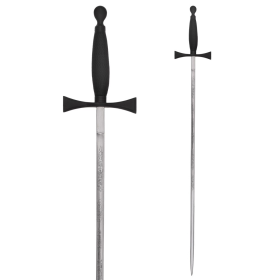
Ritual Masonic Sword with Black Cross, 32" with sheath
Ritual sword with black cross guard

Ritual swords are still used today, for example during Templar and Masonic ceremonies.
The appeal of this sword lies in its consistent design and color scheme. The crossguard is shaped like two arms of a pawed cross. Together, the blade, the handle and the guard reproduce the shape of the Christian cross, as the Knights Templar, among others, used to portray it.
The non-sharp blade is adorned with engraved ornaments.
The sword comes with a matching steel sheath soured in black leather.
Irish cape sword with ring apple, incl. Sheath
This one-hand sword is based on several original finds and 16th-century drawings of kerns (ceithern), the light infantry men who constituted most of the Irish forces in the late Middle Ages and the Renaissance. These Gaelic warriors, mainly mercenaries, proved their ferocity in many conflicts in the British Isles.
Scottish sword basket , includes sheath
The Basket-Hilt Backsword of Hanwei is replicated from an original in the collection of the Royal Armouries in England dating from about 1760. It is likely that the original sword blade was made in Germany a century earlier and re-wielded as the designs of the baskets were refined. It has an unusual basket with double engraved plates of "horned beast" and a blade with twin fullers for most of its length.
Viking Sword
Replica of a Viking sword designed with a very complex fist made of brass.

The carbon steel blade contains the typical wide spike of Viking swords.
Because of this, the weight is only 1000g.
A true presentable specimen.
English Reverse Sword
Brave is a short and light sword, to load, draw, be agile, strike, cut, stock strong and fast - Paradoxes of Defense, George Silver, 1599.Cold Steel® is proud to add its interpretation of a 17th-century English funerary sword to the line. Inspired by historical examples, this agile one-hand sword is quick and alive in hand and an absolute pleasure to train. Able to hit a decisive blow even by cutting quickly on the wrist, this beautiful sword has proven to be very popular with the Cold Steel crew®, who proclaimed it to be one of their favorite one-hand cutters.
Viking Sword
Nice reconstruction of a 10th-century Viking sword, based on archaeological finds made in England.
Already in the 8th century, isolated groups of Vikings descended sporadically on British shores in search of an easy saque. However, from the 9th century, the Scandinavians changed their strategy and began to conquer lands and settle in England.
Baskethilt Scottish Sword with Steel Scabbard
These Brass Basket Hilt championship swords are used in many championships in Scotland and the World Highland Dance Championships.
Each carbon steel sword is made with a polished solid brass hilt and comes with its own scabbard. These cost a sword and a scabbard. Two are needed to make a double fist set of the championship.
Functional Normandy Sword
With their distinctive cruciform protector and Brazil nut pommel, they are similar in weight and static balance and offer virtually identical handling characteristics. Both are harmonically balanced, optimizing the handling characteristics for the re-enactor in the case of this hard-hitting version.
The blade is forged in 5160 high carbon steel and marquenched to HRC 50-52, providing anti-burr safety. The grip is wooden and covered with leather on a drawstring coating.
Norman sword for practices

Normandy sword for hand forged practices with oil-hardened carbon steel blade and blunt tip. Handle covered with brown leather. It was used in the battle of Hastings in the year 1066 of the Normans against the English. Includes leather covered wooden sheath