Active filters

  • Categories: Elmos Templarios clear
  • Categories: Porta Chaves and Imanes Templarios clear
  • Categories: Templarios Swords clear
Sword of Hugo Payens
Hugo de Payens sword with Cross sheath, first, France. Conclusions in brass or nickel. Hugo Payns (1070-1136) was the first grand master and founder of the Order of the Temple and one of the first nine knights. Born in 1070 in Payns Castle, near Troyes, France, and died in Palestine in 1136.
Helmet Maciejowski
Also known as the barrel helmet (helmet pot or pot), the Maciejowski Helmet was the forerunner of what would later become the Great Elmo (or heaume) of the 14th century.
This reproduction is made of solid steel of 18 caliber and has a protective cross on the face. The fabric lining and chin strap allow for a perfect fit.

Dimensions: 32 cm high, 20 cm wide
Weight: 2,270 g
€288.50
Helm of the Golden Bread Templars
This Sugarloaf Templar helmet consists of a conical upper and is decorated across the front with the cross of the Knights Templar. Handmade in 18 gauge steel. The Templar SugarLoaf helmet is padded from the inside and has a soft, adjustable lining.
€250.29
Helmet , William of Staunton, 1326 AD
Great Helmet, William of Staunton, 1326 AD, 1.6 mm steel
- ready for battle -

This helmet is a reconstruction of an image on a stone relief depicting William of Staunton, dated 1326 and displayed at staunton church, Norfolkshire, England.

€158.08
Crosssword with sheath, functional
Medieval sword a hand with disc button. Hand forged in EN-45 steel with heat treatment. The blade is threaded to the button. It has a hardness of 48-50 HRC. Leather strap covered leather. The tip of the blade is rounded and the edges are blunt. Includes leather hem coated in leather.
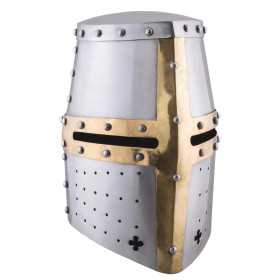
Helm Crusaders
Large medieval helmet with brass accessories and leather lining,14º C., 1.6 mm steel
€196.80
Elmo Crusaders ready for battle
Crusader helmet, 2 mm steel
- ready for battle
A replica ready for the battle of a helmet of the late 12th century worn by the knights of the Christian orders, such as the Hospitalries and Templars during the Crusades. It's a flat top helmet with a large front plate. The helmet is made of steel 2 mm sheets that are all connected and fixed by rivets. A comfortable, adjustable and padded padded lining is riveted into the helmet, as well as a leather strap with brass buckle.
This helmet is available in sizes M and L.


size
max. head circumference
Internal distance back to forehead approx.
Internal distance ear to ear approx.
Weight approx.


m
61 cm
22 cm
19 cm
3.3 kg


I
64 cm
23 cm


20 cm3.5 kg
€215.25
Functional Crossed Accolade Sword with Sheath
Knight Templar functional hand-forged sword with 1065 carbon steel blade looking for optimum balance, speed and durability.

It includes a sturdy leather covered wooden hem and a vintage ribbon with solid metallic hardware.
The button carries a very detailed Templar coin on each side with a Latin inscription and the symbols representing the Order of the Temple.
The handle is coated in red leather, surrounded by a metallic thread.
Great King's Helmet with crown, 1.6 mm steel
The so-called Great Helmet (also called a large helmet, large heaume, pot helmet, bucket helmet or barrel helmet) was often worn on a smaller and lighter helmet (e.g. a cervelliere/secret helmet) and was widespread throughout Central Europe in the Middle Ages. Numerous historical illustrations, miniatures and finds from Germany, Flanders, England, Italy, Switzerland, Austria, etc. testify to the popularity of this particular type of helmet at the time. These helmets emerged during the Crusades in the late 12th/ early 13th century. and were commonly used by knights until the mid-14th century.
€210.77
Sword Templaria Damascus
Damascene Extraordinary da Damascene with open blade and 48 inches. Between 1108 and 1118, three religious-military orders were created to help and protect pilgrims who were going to the holy places. The Order of the Poor Knights of Christ, later known as the Order of the Temple, the Order of Hospitals of St. John of Jerusalem and the Order of teutonic Hospital brothers.
Pope Innocent II recognized the order of the Temple in the year 1139. The seal of the Templars, insignia of the order;  Two riders mounted on the same horse represent the dual vocation of the order, religious and military. With a Latin inscription that says sigilum militum Xpisti (Seal of the militia of Christ).